
Looking out of the cueva del Milodon toward the "Sena de la Ultima
Esperanza"
The road leading out of Puerto Natales is paved and curves along the Bay of Last Hope (Seno Ultima Esperanza), past cormorants, drifting flocks of black-necked swans and the now-silent meat plant. Here the road turns to gravel and dirt, and as there is lots of speeding traffic (mostly mini buses heading towards the park) the gravel is soft and the washboard vicious. After about 15 km, I turn left to follow the signs to "Cueva del Milodon" and eventually pass the "Silla del Diabolo", an isolated rock that stands about 100 feet high, shaped like a sugar cube, in the midst of cow pastures and "lenga" trees. I pay my fee to get into the cave: yes, they’ll look after my bike, just park it beside the warden’s window, and I can refill my water bottle at the tap behind the next building. I follow the paved path towards the hillside, and stop spell-bound before the yawning mouth of the cave. This is the cave of the Mylodon, a prehistoric giant sloth, whose hide was found in the cave, and a piece of it was kept by Bruce Chatwyn’s grandmother where it cast a spell over little Bruce and thus became responsible for one of the most fascinating books I know: "In Patagonia", published in 1977. The cave is 200m deep, 80 wide at the mouth and 30 m high. It’s shaped like a sock, and the wide mouth admits light enough to let you walk to the back without a flashlight. A path has been built so one can walk its length and a life-sized statue of the Mylodon stands near the exit so kids and adults alike can gawk at it. I am trying to picture where the hide had been found, but there are few indentations in the firm floor of the cave and these are probably the consequence of the greedy folks that used dynamite to get at more artifacts. In perfect innocence I do look around for "a few reddish hairs" or the strange "pebbles" that were imbedded in the Mylodon’s skin as armor, but see none; I am many years too late to be able to re-live Chatwyn’s adventure.

I went back to the Cueva and Silla del Diablo twice more. It's more than the big cave,
it's a park about two km long and half a kilometer wide, the hill sides riddled with more
caves and meadows, bush thickets and Lenga (Southern Beech) groves below. By visiting there several times, I became well-known to the park attendants, and they
kidded around.
By visiting there several times, I became well-known to the park attendants, and they
kidded around. 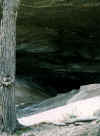 I was a suitable diversion to their
otherwise humdrum job of manning the park office. The last day before leaving on the ferry
I spent in the park, sitting under shady trees at a picnic table catching up in the diary,
listening to the birds with no one else around and eventually lying down for a two-hour
snooze. If you go there, check out the Cueva Chica: it's small but deep and, with a flash
light and the courage to crawl in tight spaces, you can explore is tunnel at the far
end.
I was a suitable diversion to their
otherwise humdrum job of manning the park office. The last day before leaving on the ferry
I spent in the park, sitting under shady trees at a picnic table catching up in the diary,
listening to the birds with no one else around and eventually lying down for a two-hour
snooze. If you go there, check out the Cueva Chica: it's small but deep and, with a flash
light and the courage to crawl in tight spaces, you can explore is tunnel at the far
end.